
Feith is FedRAMP Moderate Authorized Read the release
Feith
Defense & intelligence

One platform for the classified enterprise.

Records, declassification, FOIA, and mission case work, on one DISA-JITC-tested platform, from unclassified through IL7 (TS/SCI).

IL7 (TS/SCI)
30+ federal ATOs, up to IL7 (TS/SCI).
3
DoD networks: NIPRNet, SIPRNet, JWICS.
8180.01
DoDM 8180.01 aligned: DoD's electronic records framework.
20+ yrs
JITC-tested 2002–2023 under the now-retired 5015.02-STD.
Credentials

Certified, accredited, and cleared for classified work.

Feith is DoD-focused and security-first: DoDM 8180.01–aligned, accredited through Impact Level IL7 (TS/SCI), and operating on classified networks today.

  • DoDM 8180.01 aligned
  • Certified for baseline and classified records; JITC-tested 2002–2023 under DoD 5015.02-STD (now retired)
  • DoD Impact Levels up to IL7 (TS/SCI) — 30+ federal ATOs
  • FedRAMP Moderate authorized
  • NIPRNet, SIPRNet, and JWICS operating experience
  • AWS Top Secret C2S, AWS Secret, GovCloud, Azure Government
Proof

One Pentagon award. One CIO on the record.

In 2020 the Defense Commissary Agency received the DoD CIO Award for its rollout of Feith RMA iQ — recognizing DeCA's move from paper and disconnected systems to a fully integrated, automated electronic records environment across 250 sites worldwide.

DoD CIO · 2020

“A fully integrated, fully automated, and cost-savings records management solution that fosters rapid information sharing across the Defense Commissary Agency.”

Dana Deasy Chief Information Officer, U.S. Department of Defense

Beyond DeCA Feith serves DoD components, Joint and Combatant Commands, and U.S. Intelligence Community agencies across the full mission records lifecycle. Customer identities are not published, by direction.

Operating environments

Authorized at every classification, from unclassified through IL7 (TS/SCI).

Three classification environments. One platform underneath. Authorizations on file for each.

An analyst annotating an operations map inside a secure facility
Inside the enclave: work conducted at the classification of the deployment.
  • Unclassified and CUI

    Networks
    NIPRNet; public internet via authorized gateways.
    Clouds
    AWS GovCloud, Azure Government, on-premises.
    Authorization
    FedRAMP Moderate authorized; DoD IL4 (AWS GovCloud).
  • Secret

    Networks
    SIPRNet.
    Clouds
    AWS Secret Regions; on-premises DoD facilities.
    Authorization
    DoD IL6.
  • Top Secret / SCI

    Networks
    JWICS.
    Clouds
    AWS Top Secret C2S; on-premises IC facilities.
    Authorization
    ICD 503 and agency-specific accreditation paths.
The platform, for this audience

Every mission workload. Every classification. One platform.

Records, declassification, FOIA, and case work run on the same Feith platform civilian agencies use, with classification, clearance gating, and cross-domain controls layered in.

Records management at classified scale

RMA iQ is built to DoDM 8180.01, with the legacy DoD 5015.02 classified-records certification (JITC-tested 2002–2023) behind it. The same engine scales to tens of millions of records and runs at Impact Levels up to IL7 (TS/SCI). Classification, supplemental markings, clearance gating, and immutable audit trails are first-class features, not add-ons.

Declassification on the same platform

Declassification iQ runs systematic, automatic, and discretionary review under Executive Order 13526. Mandatory Declassification Review (MDR), FOIA referrals, and appeals run through one case engine with full chain of custody. AI proposes exemption-based recommendations against the nine categories; trained analysts review, modify, and decide. Records and declassification share one platform, one access-control model, and one audit history, so a record that is declassified never has to leave the system that managed it.

AI inside the perimeter

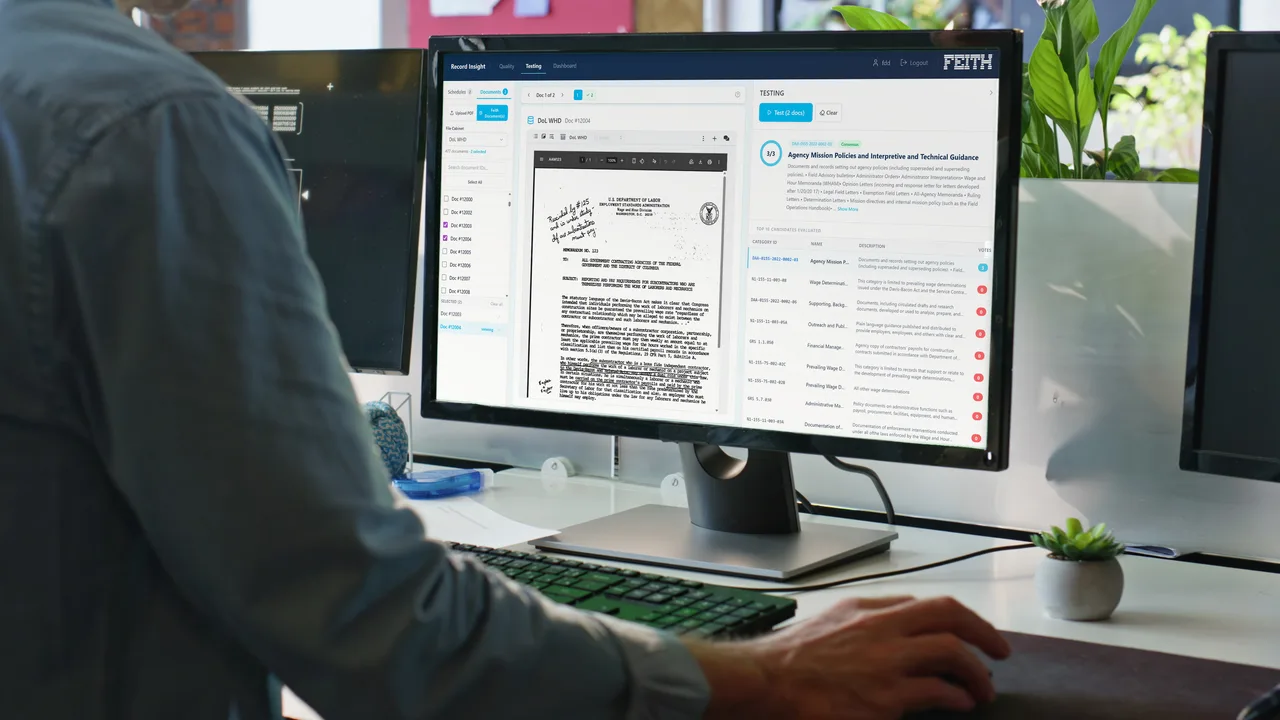
Feith's AI runs where the records live. In classified deployments, inference happens inside the authorized enclave on infrastructure you control: no external API calls, no data egress, no model retention. Use Feith's models, bring your own, or run without AI at all; the choice is per-environment and reversible. AI Document Processing classifies records, applies retention, proposes redactions, and routes case work. Record Insight categorizes records against your retention schedules, with written reasoning and an audit entry on every decision. Every AI component can be disabled, audited, or replaced.

Defense FOIA and mission case work

Defense agencies field FOIA at civilian-agency volumes, on top of records held at multiple classification levels. FOIA Workbench answers the specific demand: classification-aware search across the vault, automated exemption identification with deep coverage of b(1) national-defense and b(3) statute-protected information, equity review and consultation tracking across components, and final declassification before release. Case Manager runs the same workflows for non-FOIA matters (investigations, inspections, IG queries, and policy actions) on the same vault, markings, and audit trail.

What it looks like when this works

Three concrete outcomes.

What changes for defense and intelligence agencies running on Feith.

01

Records

Agencies move from paper and disconnected systems to one DoDM 8180.01–aligned electronic records environment, with disposition automation, audit trail, and retention applied at the document level.

02

Declassification

The 25-year automatic review obligation under EO 13526 becomes a managed pipeline that stays current. Analysts review AI-prepared candidates against the nine exemption categories instead of starting from scratch on every document.

03

Case work and FOIA

Classification decisions and exemption recommendations that used to take hours of manual review are proposed in seconds. Humans still decide, and the audit trail explains exactly why.

What governs this work

Built against the standards that govern classified records.

The mandates DoD and IC records leaders work to, and what Feith does about each.

  • DoDM 8180.01

    Electronic records management for DoD IT (2023).

    The Pentagon's benchmark for electronic records management: retention, metadata, capture, storage, maintenance, access control, and reporting. Feith's products are built to meet each requirement.

  • DoD 5015.02-STD v3 (legacy)

    Records management application certification.

    • Certified for baseline and classified records.
    • Tested under the DISA Joint Interoperability Test Command (JITC).
    • Held continuously from 2002 until the program was retired in 2023, when DoDM 8180.01 superseded it.
  • 2023 DoD Records Strategy

    Records as national assets.

    The strategy treats records as decision-support assets, not administrative overhead, which means curation, automation, and lifecycle governance all have to live in one system. RMA iQ is built that way.

  • Executive Order 13526

    Classified information governance.

    EO 13526 governs the classification, declassification, and safeguarding of national-security information. Declassification iQ implements automated, systematic, and discretionary review against it, including the 25-year automatic obligation, and the supporting ISOO directives, CIPA, and Public Interest Declassification Act framework.

Security posture

Built American. Built single-tenant. Built for one mission at a time.

The architecture that lets Feith be authorized at the levels above.

Single-tenant

Every customer is structurally isolated, with no multi-tenancy at any layer of the stack. The only deployment model Feith has ever offered — an architectural decision the company has never reversed.

Built American

  • All support, development, services, and engineering happen inside the United States.
  • No Foreign Ownership, Control, or Influence (FOCI).
  • FAR 52.204-24 and 52.204-26 compliant. No Covered Equipment; no foreign technology-threat dependencies.

Classification enforced at the document

Classification and supplemental markings are enforced at the document level: a user without the clearance and markings cannot find, view, or retrieve a record. ABAC and RBAC layered, with CAC, PKI, and external credentialing.

Cross-domain and multilevel security

Multilevel Security and Cross-Domain Solutions let one Feith deployment serve users at different clearances and move data across classification boundaries under policy. Secure Reading Rooms enable controlled disclosure inside the platform's perimeter.

Institutional

The vendor-longevity question, answered.

Most software companies that held DoD records in 1979 are gone. Many of the vendors that hold DoD records today have been acquired or sit under foreign-owned holding companies. Feith Systems is neither: founded in 1979 in Fort Washington, Pennsylvania; privately held, American-owned, and still run by the family that started it. First DoD contract in 1995. DISA-JITC tested from 2002 to 2023. The next administration will not be its first transition, and the next 8180 revision will not be its first either.

1979
Founded in Fort Washington, PA.
1995
First DoD contract.
2002
First DISA-JITC certification.
2020
DoD CIO Award (DeCA).
Donald Feith, founder of Feith Systems & Software.
Donald Feith Founder & CEO · est. 1979
Next step

Talk to someone who has actually done this.

Feith's federal team includes cleared personnel and career federal records experts. Book a working session on Teams, in person, or in your SCIF.

In the briefing
  • Records, declassification, FOIA, and case work mapped to your environment.
  • Authorization ceiling, networks, and cloud posture aligned to your stack.
  • Procurement-vehicle alignment for your contracting path.
Schedule a briefing

Prefer email? Request the compliance matrix at more-info@feith.com.

Available through
GSA MASCarahsoft
Federal contracts desk ›