
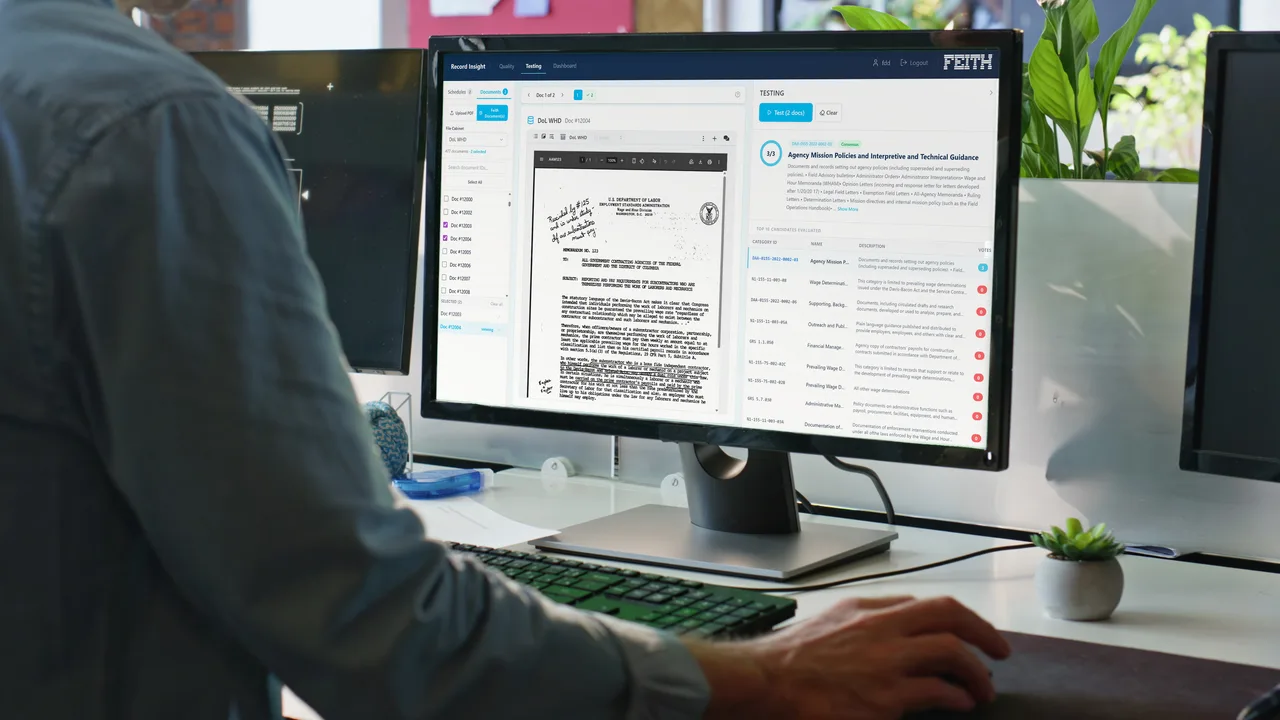
Categorization, with the reasoning shown.
Record Insight reads each record and categorizes it against your agency's Records Control Schedule and the NARA General Records Schedule. Every decision arrives with a confidence score, a written reasoning, and the audit-trail entry that makes it defensible.
You can't manage a record you can't categorize.
Most of an agency's records arrive unstructured and barely described, scattered across OneDrive, SharePoint, network drives, and shared inboxes, with file names and metadata that say little about what's inside. Until each one is matched to a retention schedule, it can't be retained, disposed, or defended.
Rules need structure that isn't there
Rule-based categorization keys off fixed fields, templates, and folder paths. Unstructured records don't have them.
Metadata is missing or misleading
A file named “final_v3.docx” in a personal drive tells you nothing about which records schedule should govern it.
Location doesn't equal content
Where a record happens to live says nothing about what it is, or how long it must be kept.
AI that reads records the way a person would.
Built into RMA iQ (Feith's full-lifecycle records platform), Record Insight is the next generation of auto-categorization. It understands a record by its content, metadata, and purpose, assigns it to the right NARA GRS or RCS category, and preserves it through to final disposition.
- Reaches the records traditional auto-categorization can't: the unstructured content sitting in drives and shared inboxes with no usable metadata.
- Adds to your existing categorizers rather than replacing them: it sits alongside the rules-, metadata-, and location-based ones you already run.
- Flags weak schedule descriptions before they cause misfiles: it scores each category description against a structured set of readiness questions and points out what needs clarifying.
Categorized, justified, and dispositioned, grounded in your own schedule.
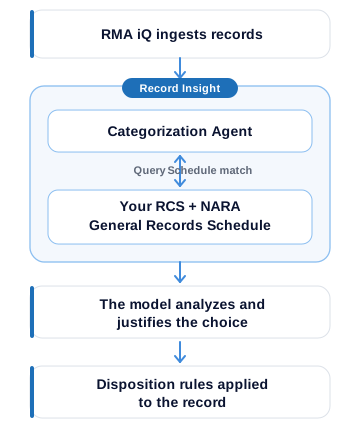
Record Insight's Categorization Agent retrieves the matching schedule first, then asks the model to justify the fit, so every decision is anchored to your own rules and the schedule it just retrieved.
No rules to maintain
It understands the records instead of relying on rules someone has to configure and keep current.
No training required
Record Insight reads against your retention schedule directly, applying your rules as written.
No hallucinations
Every categorization is grounded in your record control schedule, with the reasoning attached.
One pass, five layers of labels.
Record Insight reads everything the record can tell you, then puts each layer to work downstream.
PII, PHI, CUI-Export, ITAR Cat XVIII
Drives ABAC access and inline encryption.
TR-05 five-year, GRS 1.2 destroy-after-audit
Starts retention timers and legal-hold wiring.
Contracts, HR-Personnel, Budget
Powers search facets and workload routing.
Parts and sub-parts of an aircraft
Feeds analytics and knowledge graphs.
Attorney-client privilege, FOIA-Exempt (b)(6)
Directs review and redaction workflows.
Five more AI capabilities, one platform.
Each shares the same permission model, the same audit trail, and your choice of large language model.
Prompt Runner
Run custom AI prompts across record sets for extraction, routing, and reasoning.
See the deep-dive 03AI Dashboards
Build dashboards and analytics on records activity from a plain-English brief.
See the deep-dive 04Ask Me
Chat with your records: permission-aware, and cited to the source.
See the deep-dive 05AI Redaction
FOIA, PII, and CUI redaction suggestions, with reasoning, reviewer-approved.
See the deep-dive 06Feith MCP
Connect Claude, Copilot, OpenAI, or in-house agents to your Feith content.
See the deep-diveManage every record, even the hardest to reach.
Request received.
Thanks. We'll reach out to set up your Record Insight walkthrough.