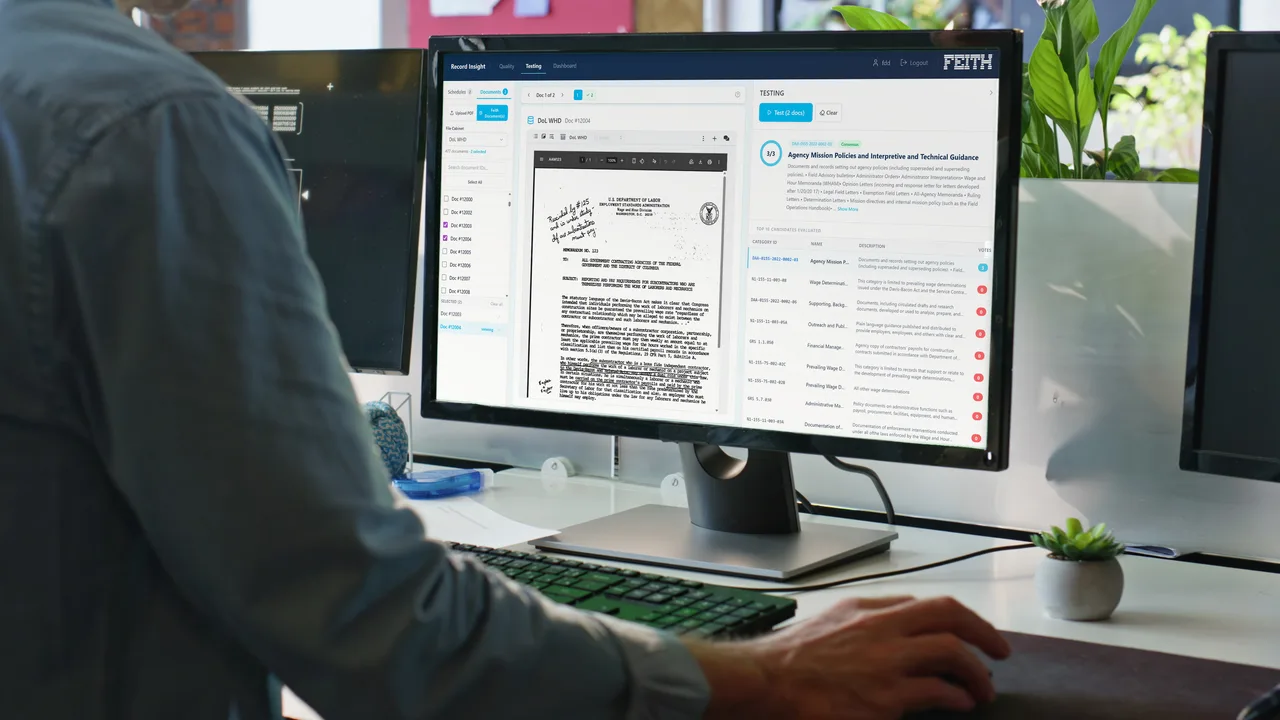
Storage substrate
Encrypted object storage with optional shared file-system access. Federal-grade encryption at rest and in transit, with customer-managed keys for agency-controlled encryption.

The document repository inside the Feith Platform: running in FedRAMP cloud, your own agency cloud, on-premises, or a classified enclave. One product, single-tenant from day one, for your agency's most sensitive documents.
Capture every record, enforce every rule, automate every response, in one governed lifecycle, across cloud or on-premises.
A federal-grade content store with versioning, immutability, encryption, and an indexable metadata layer. A record retrieved ten years from now is the same record captured today, byte for byte, with its provenance attached.
Encrypted object storage with optional shared file-system access. Federal-grade encryption at rest and in transit, with customer-managed keys for agency-controlled encryption.
Every change creates a new version, with who made it. Compare versions and roll back when you need to.
Hash-based de-duplication catches identical files at ingest, across the repository, without losing per-document metadata, audit history, or permissions.
Every document gets a Feith-issued identifier at ingest that persists through renames and retention transitions: the basis for chain-of-custody.
System metadata plus configurable agency fields, all indexed and searchable, populated by AI on ingest and edited inline in the workspace.
Feith Document Management is one codebase that deploys into the environment your data is legally required to live in, with the same workspace and audit trail underneath.
Runs in Feith's FedRAMP-authorized cloud at Moderate impact. The managed, continuously-monitored path for agencies that don't want to operate the infrastructure.
Deploys inside your own authorization boundary (AWS GovCloud or Azure Government) on infrastructure you already run. You keep identity, logging, and data residency.
Installs in your own data center, disconnected from any vendor cloud. The full repository, workspace, and audit trail run on hardware you own.
Operates inside classified enclaves through TS/SCI, air-gapped included, with ATOs across DoD Impact Levels up to IL7: the same product in-boundary, no degraded feature set, AI models inside the enclave.
FedRAMP Moderate authorized · STIG compliant · FISMA aligned · NIST 800-53 · NARA UERM aligned · ATOs across DoD Impact Levels up to IL7 (TS/SCI)
Specific assists at specific moments, each running inside your own authorization boundary. Document content never leaves for an outside model. Each one is grounded in the document in front of you.
Open a 60-page environmental impact statement and a three-bullet TL;DR sits in the right rail, each bullet linked to its source paragraph. Grounded in the document itself, so it's consistent and auditable.
As a memo lands, the AI labels the CUI, PII, and PHI it finds, so encryption and access controls apply from the start. Detection follows your agency's own taxonomy.
Ask a question of the open document directly (“What's the period of performance?” “Who signed?”) and answers come back with clickable paragraph citations, scoped to that document alone.
Open a contract and the assist extracts its renewal date, ceiling value, FAR clauses, and party names into metadata, ready to drive renewal alerts.
Feith AI also runs in Automatic Extraction, Record Insight, and Workflow & Automation. See AI in Feith.
Federal document volume defeats folder browsing. Finding the right record means searching content, metadata, and context together, and trusting the result set is complete and scoped to what the user is allowed to see.
Search document content and every configured metadata field at once. Results respect the user's permissions, so a document they can't access never appears.
Narrow by record type, retention category, date range, agency metadata, or sensitivity. Filters compose, so a broad search resolves to the exact set in a few clicks.
Frequent queries save as reusable views. A FOIA officer's “responsive to active requests” or a records officer's “eligible for disposition this quarter” stays one click away.
AI populates the metadata that makes content findable at ingest, and Ask Me answers against a document directly, so search works on day one, not after a tagging backlog.
Document work is collaborative and continuous. Feith Document Management keeps it in one place, with every change versioned and every action logged, so collaboration never costs you the audit trail.
Changes can't be made without the knowledge or approval of the document's owners, and every revision is captured with who made it.
Comment, redline, and annotate without altering the source. Markup is its own attributed, timestamped layer, retrievable alongside every version.
Send a document through signature, review, or approval with Workflow & Automation. Each step is recorded, and the routing history becomes part of the record.
Compare any two versions side by side and see exactly what changed between them, down to the character.
In federal records, who can see a document and who did what to it are part of the record. Feith Document Management enforces access at the document level and logs every action immutably.
Permissions resolve from role, clearance, and document attributes, including privilege-aware and CUI/PII-aware rules, enforced at the repository itself, on every request.
Every view, edit, share, and disposition writes a signed, timestamped entry. The log can't be altered or deleted, and it exports for the Inspector General on demand.
CUI, PII, and other sensitive data can be detected as content is captured. Once flagged, access controls apply automatically to govern who may view, edit, or share it.
The people who manage records, administer the system, and audit it are distinct roles with distinct powers. No single account can both act and erase the evidence of having acted.
Feith Document Management is the hub every other Feith capability reads from and writes back to: one governed repository underneath the whole platform.
Documents arrive from M365, Google, file shares, email, and line-of-business systems, captured into the repository with their metadata intact.
Reads each document at ingest and populates its metadata, so content is findable and classifiable the moment it lands.
Applies NARA-compliant retention and defensible disposition to the documents Feith Document Management holds, turning content into governed records.
Reads across the repository to categorize content against the agency's schedule, with its reasoning cited.
Routes documents through review, signature, and approval, and orchestrates AI inside multi-step processes with Prompt Runner.
The same repository serves different missions. Four ways agencies configure Feith Document Management: same product underneath, different metadata schemas, workflows, and agency vocabulary.
Contracts, modifications, task orders, vendor correspondence.
Memoranda, opinions, case files, litigation holds.
Case-centric collections: hundreds of related documents, decisions, and embedded approvals in one case.
Agency-issued policies, directives, manuals, and superseded versions.
For agency-wide case management, see Case Management. For records compliance across all four missions, see RMA iQ.
In production across civilian, defense, and intelligence missions.
Prefer to read first?
Thanks. We'll reach out shortly to set up your demo.